At any given moment, there are roughly 10,000 aircraft flying over the Earth. Every single one of them is being tracked, guided, and sequenced by someone on the ground. That’s not an exaggeration. It’s just Tuesday in the world of air traffic management. Most passengers never think about what happens between pressing their seatbelts and touching down safely. But behind every uneventful flight is a layered, carefully coordinated operation that runs 24 hours a day without pause. This post pulls back the curtain on how that system actually works, from the airspace above your head to the people watching radar screens in dimly lit control rooms.
The Layers of Airspace and Who Controls What
The sky isn’t just open space that planes fly through freely. It’s divided into structured layers, each one with defined rules, altitude limits, and assigned controllers responsible for what happens inside it. Aviation authorities classify airspace ranging from Class A down to Class G, and each class determines what kind of aircraft can fly there, what communication is required, and how much separation controllers need to maintain.
Air traffic management works because these boundaries are clear and the handoff process between them is precise. As a flight climbs out of an airport, it passes from tower controllers to departure controllers and then into the hands of en route controllers managing a much larger piece of sky. Each handoff involves a transfer of communication and responsibility. The receiving controller already has the flight on their radar before the handoff happens.
Inside an Air Traffic Control Tower
Ground Control and Surface Movement
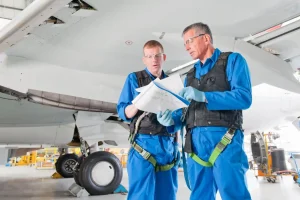
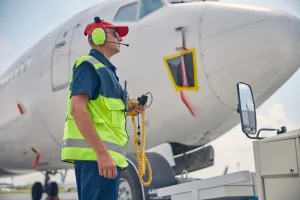
Before a single aircraft lifts off, ground controllers are already working. Their job is to manage everything that moves on the airport surface: planes taxiing to runways, planes vacating after landing, fuel trucks, maintenance vehicles, and the complex choreography of getting multiple aircraft to the right place at the right time without anyone crossing the wrong line.
Preventing runway incursions is one of the most serious responsibilities in ground control. A runway incursion happens when an aircraft or vehicle enters an active runway without clearance. The consequences can be catastrophic. Ground controllers constantly coordinate with airline operations teams and tower controllers to keep sequences tight and clearances unambiguous. Every instruction is specific, every readback is confirmed, and nothing moves without explicit permission.
Tower Controllers and the Final Approach Sequence
Tower controllers handle the most time-critical phase of any flight: the last few minutes before landing and the first few minutes after departure. They are managing aircraft that are close together, moving fast, and operating in conditions that can change quickly. Their core job is to maintain separation between aircraft and issue landing and departure clearances in a sequence that keeps traffic flowing without gaps or conflicts. During peak periods at a busy airport, a tower controller might be managing multiple aircraft on final approach while simultaneously clearing departures between them.
Separation standards set the minimum distances that must be maintained between aircraft. These standards change depending on aircraft size, speed, and the weather conditions at the time.
En Route Control and Managing High-Altitude Flight Paths
Once an aircraft climbs above the terminal area, it enters en route airspace managed by large control centers that cover hundreds of miles. In the United States, these are called Air Route Traffic Control Centers. In the UK, NATS operates similar facilities. These centers manage aircraft traveling long distances through their sector, often at cruise altitude between 30,000 and 40,000 feet. En route controllers work with a much larger picture than tower controllers, tracking aircraft across wide geographic areas and planning for potential conflicts well before they develop.
Flight level allocation is one of the key tools in en route air traffic management. Aircraft traveling in opposite directions are assigned different altitudes to prevent head-on conflicts. Aircraft on crossing paths are separated either by altitude or by timing, with controllers adjusting speeds or issuing turns to create the necessary distance.
Technology That Makes Modern Air Traffic Management Possible
Radar Systems and Surveillance Tools
Primary radar works by sending out a signal and measuring what bounces back from an aircraft’s body. Secondary surveillance radar goes further by interrogating a transponder on the aircraft, which replies with specific information, including the flight’s identity and altitude. Together, these systems give controllers a detailed picture of everything in their airspace. More recently, ADS-B technology has changed the game significantly. Aircraft equipped with ADS-B broadcast their own position, speed, and altitude directly to ground stations and to other aircraft. The result is a more accurate and more frequent position update than radar alone can provide.
Decision Support and Automation Tools
Controllers today work alongside software that monitors separation continuously and flags potential conflicts before they become emergencies. These conflict detection tools don’t make decisions. They surface information so the controller can act earlier and with more confidence. Flow management tools work at a higher level, helping Traffic Management Units anticipate traffic surges and coordinate ground delays or reroutes before a problem reaches the radar screen. The technology assists, but every clearance, every instruction, and every judgment call still comes from a human being. That balance is deliberate, and it matters.
Managing Traffic Flow During Peak Hours and Disruptions
A busy hub airport doesn’t just handle aircraft one at a time. It manages waves of traffic arriving and departing in scheduled banks, often with dozens of aircraft in the air simultaneously within a 50-mile radius. Traffic Management Units sit above individual control sectors and take a strategic view of the whole picture. When arrival demand exceeds airport capacity, they issue Ground Delay Programs that hold aircraft at their origin airports rather than letting them take off into congestion. It’s far safer and more efficient to delay a flight on the ground than to hold it in a stack over a busy airport, burning fuel.
When weather closes a runway or a major event disrupts normal operations, air traffic management facilities coordinate reroutes across entire regions. Airlines, airports, and control centers share information in real time to find alternatives and minimize the knock-on effect across the network. A closure at one major airport can ripple across a continent if it isn’t managed quickly and collaboratively. The system is designed to absorb disruption, but it takes active coordination at every level to keep the ripple from becoming a wave.
Communication Standards That Keep the System Intact
Aviation communication follows a strict set of phraseology standards developed over decades of operational experience. Every word has a specific meaning. Nothing is left to interpretation. When a controller issues a clearance, the pilot reads it back in full, and the controller confirms it was received correctly. This read-back and hear-back loop creates a closed circuit of verification that catches misunderstandings before they become incidents. Many of the communication protocols in use today exist because something went wrong in the past, and the industry learned from it.
ATIS, the Automatic Terminal Information Service, broadcasts routine airport information on a dedicated frequency continuously. Weather conditions, active runways, and any relevant notices are updated regularly and assigned a letter code. Pilots listen to ATIS before contacting the tower, which means controllers don’t have to repeat the same information to every arriving and departing aircraft. It’s a simple idea that significantly reduces controller workload during busy periods.
Conclusion
Air traffic management is one of those systems that works so well that most people never have to think about it. The layered airspace structure, the tower and en route controllers, the radar and automation tools, the strict communication standards, and the carefully trained professionals behind every screen all function together to move millions of people through shared airspace every single day. As traffic volumes grow and new types of aircraft, including drones and urban air taxis, begin entering the mix, the discipline will keep adapting. But the core of what makes it work has always been the same: clear structure, good communication, and people who take the responsibility seriously.
Frequently Asked Questions
Q1. What is air traffic management, and how is it different from air traffic control?
Air traffic management is the broader system covering airspace design, traffic flow planning, and coordination. Air traffic control is one part of that system, focused on direct communication with pilots in real time.
Q2. How do air traffic controllers prevent two aircraft from colliding in busy airspace?
Controllers maintain separation standards by assigning different altitudes, speeds, and routes to aircraft. Radar, conflict detection software, and strict communication protocols all work together to keep aircraft safely apart at all times.
Q3. What technology do air traffic management centers use to track aircraft positions accurately?
Primary radar, secondary surveillance radar, and ADS-B are the main tools. ADS-B allows aircraft to broadcast their own position data directly, giving controllers more frequent and accurate updates than traditional radar alone provides.