Commercial aviation is statistically the safest form of long-distance travel in human history, yet most passengers board a plane with almost no understanding of the layered system that makes that record possible. Aviation safety standards are not a single regulation or a single agency. They are an interconnected architecture of international rules, national enforcement, airline protocols, and continuous improvement systems operating simultaneously on every flight, every day.
The Global Regulatory Framework Behind Commercial Flight Safety
Aviation safety is one of the few industries where international regulatory alignment genuinely works. The International Civil Aviation Organization, known as ICAO, is the United Nations body responsible for establishing the baseline aviation safety standards that member states are expected to adopt. ICAO does not directly regulate airlines but sets the framework that national authorities translate into enforceable law through what are called Standards and Recommended Practices, or SARPs.
National bodies like the FAA in the United States, EASA in Europe, and CASA in Australia take those frameworks and turn them into regulations with real enforcement power. These agencies certify airlines, oversee aircraft manufacturers, and audit maintenance organizations on a regular basis. The differences between national implementations are carefully managed through bilateral agreements that ensure an aircraft certified in one country can operate safely in another.
Aircraft Certification and Airworthiness Standards
Before any commercial aircraft carries a single passenger, it must pass one of the most rigorous certification processes in any industry. Manufacturers must demonstrate that a new aircraft design meets every applicable safety standard before receiving authorization to operate commercially. This includes structural load testing, systems redundancy requirements, and full emergency evacuation trials conducted with real passengers, completing the process within 90 seconds. Regulatory authority oversight runs throughout the entire development process, not just at the end.
Continued Airworthiness and Maintenance Requirements
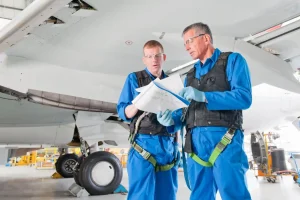
Certification is only the beginning. Airlines are required to follow mandatory maintenance schedules, comply with airworthiness directives issued in response to newly identified safety concerns, and document every single maintenance action performed on every aircraft. Maintenance organizations that carry out this work must themselves be certified and audited regularly. This documentation trail is not a bureaucratic formality. It feeds directly into safety oversight systems that track the condition and history of every aircraft in commercial service, making aviation safety standards enforceable across the entire operational life of the aircraft.
Pilot Training, Licensing, and Recurrent Standards
The standards governing flight crew qualification go far deeper than most passengers realize. Becoming a commercial pilot requires minimum flight hours, written examinations, medical certification, and type rating qualifications specific to each aircraft operated. None of this is a one-time threshold. It is the beginning of an ongoing qualification process that continues throughout an entire career.
Simulator Training and Recurrent Checks
Full-flight simulators play a central role in both initial and ongoing training. Regulators require simulators to include specific scenarios such as engine failures, severe weather encounters, and emergency procedures that would be too dangerous or impractical to practice in a real aircraft. Pilots must complete recurrent checks at regular intervals to maintain their type ratings, and failing those checks has immediate consequences for their qualification status. This commitment to continuous, scenario-based training is one of the most effective safety tools the industry has developed, and it directly supports the broader framework of aviation safety standards that govern commercial operations.
Crew Resource Management and Human Factors
A significant proportion of historical aviation accidents involved human error rather than mechanical failure. The industry’s response to this reality was Crew Resource Management, known as CRM, which transformed how cockpit communication and decision-making are trained and evaluated. CRM originated from accident investigations in the 1970s and 1980s that identified communication breakdown and rigid authority structures as primary contributing factors in otherwise survivable situations.
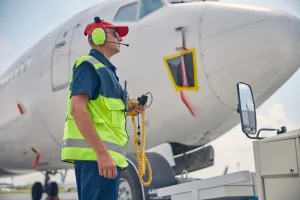
Modern CRM training covers authority gradients, assertiveness protocols, situational awareness frameworks, and decision-making under pressure. It has since expanded beyond the cockpit to include cabin crew, air traffic controllers, and ground handling teams in a fully integrated human factors approach. Threat and Error Management, an evolution of CRM, gives crews a structured method for identifying and neutralizing risks before they become incidents.
Air Traffic Control and Airspace Safety Systems
Aviation safety standards extend well beyond the aircraft itself. Air traffic controllers maintain strict separation standards between aircraft across different phases of flight and different airspace classifications. The Traffic Collision Avoidance System, or TCAS, operates as a last-resort safety net independent of ATC, issuing resolution advisories directly to flight crews when separation falls below safe thresholds. Pilots are required to follow TCAS advisories immediately, even if they conflict with ATC instructions, because the system has real-time awareness of surrounding traffic that controllers may not always have.
The transition from radar-based to satellite-based surveillance through programs like the FAA’s NextGen and Europe’s SESAR initiative is modernizing airspace management significantly. Automatic Dependent Surveillance-Broadcast technology, known as ADS-B, improves position accuracy, enables safer reduction of separation minimums, and provides better situational awareness for both controllers and crews. These technological upgrades are being incorporated into updated aviation safety standards as they prove their reliability in operational environments.
Cabin Safety Standards and Passenger Protocols
Aviation safety standards inside the cabin are as detailed and strictly enforced as those governing the cockpit. Cabin interior materials must meet flammability standards, seats must withstand specified crash load forces, and emergency equipment, including life vests, oxygen systems, fire extinguishers, and emergency lighting, must be present in regulated quantities and placements. None of this is left to airline discretion.
Cabin crew training requirements cover emergency evacuation procedures, first aid certification, fire suppression, and ditching protocols, all of which must be recertified at regular intervals. The 90-second evacuation standard requires that a full aircraft can be completely evacuated using only half its exits within 90 seconds. This test must be passed during aircraft type certification using real volunteers and real conditions.
Safety Management Systems and Proactive Risk Management
Modern aviation safety has moved well beyond reacting to accidents after the fact. Safety Management Systems, known as SMS, represent a proactive model built around identifying and addressing risks before they produce incidents. ICAO defines SMS through four core components: safety policy, safety risk management, safety assurance, and safety promotion. Regulators now audit SMS effectiveness as part of their oversight function, which means airlines must demonstrate a genuine culture of continuous improvement rather than just documented rule compliance.
Voluntary reporting programs like the FAA’s Aviation Safety Action Program allow crew members and airline staff to report safety concerns without fear of punishment. Flight Operational Quality Assurance programs analyze routine flight data to detect patterns that might indicate emerging risks. The protected, non-punitive nature of these programs is essential to their value.
How Aviation Investigates Accidents to Improve Future Safety
When incidents do occur, the investigation process is specifically designed to produce safety improvements rather than assign blame. Independent bodies like the NTSB in the United States and the AAIB in the United Kingdom operate separately from regulatory and prosecutorial functions. Their independence is structural and intentional because investigations that serve legal proceedings produce different incentives than investigations designed purely to improve safety.
The just culture principle distinguishes between honest human error and negligent or reckless behavior. This distinction is critical to maintaining open safety reporting across the industry. Final investigation reports translate into mandatory safety recommendations that move through the regulatory system and become updated aviation safety standards.
Final Thought
Aviation safety standards are not a static rulebook written once and applied indefinitely. They are a living system that learns from experience, responds to new technology, and improves through the combined efforts of regulators, manufacturers, airlines, and crews working in parallel. Every element covered in this post operates simultaneously on every commercial flight. That layered, overlapping structure is precisely what makes commercial aviation as safe as it is, and understanding it gives every passenger a reason to board with genuine confidence.
Frequently Asked Questions
Q1: What organization sets the international aviation safety standards that airlines must follow?
ICAO, the International Civil Aviation Organization, sets the global baseline standards that member states adopt and enforce through their own national aviation authorities, like the FAA and EASA.
Q2: How often do commercial pilots complete recurrent training and safety checks?
Commercial pilots typically complete recurrent simulator training and proficiency checks every six to twelve months, depending on their airline, aircraft type, and the regulatory requirements of their national authority.
Q3: What is a Safety Management System, and why do airlines use it?
An SMS is a structured framework for proactively identifying and managing safety risks. Airlines use it because regulators require it and because it consistently produces better safety outcomes than purely reactive compliance-based approaches.